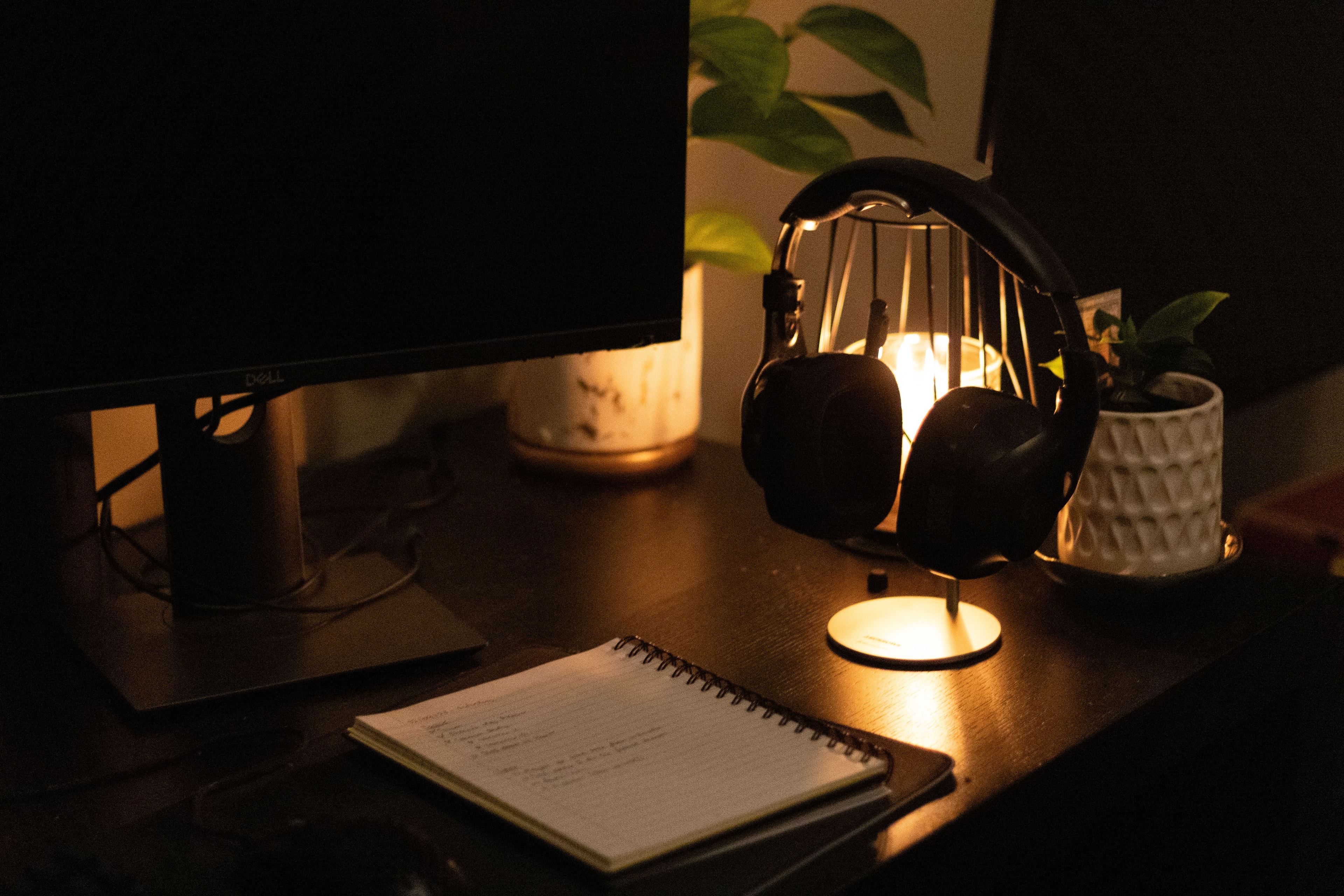
There's a particular stage every considered space passes through. The desk is in. The chair is right. The screen sits where it should. And yet the corner still reads as equipment rather than interior — functional, but not quite finished.
The distance between those two states is almost never another piece of furniture. It's the small things: the objects that organise, soften and complete a space. Accessories are where taste actually lives, because they're where nothing is bought by necessity. Every tray, stand and lamp is a choice — which is exactly why they say the most.
Five categories worth choosing well, and what to look for in each.
1. The desk tray
Clutter is the enemy of calm, but sterile emptiness isn't the answer either. A single tray — wood, leather or linen-textured — gives the loose items of a working day somewhere to belong: pen, glasses, charger, the pocket-emptying debris of the afternoon. The trick is to buy one and only one. A tray is an edit; two trays is a filing system.
Look for honest materials that will wear in rather than wear out. Walnut, vegetable-tanned leather, powder-coated steel in a warm neutral. Avoid anything with printed slogans or moulded compartments for specific gadgets — those date the moment the gadget does.
2. The monitor or laptop stand
Raising a screen to eye level is one of those changes your neck notices within a day. But a stand is also six to ten centimetres of visual mass at the centre of your space, so it needs to belong to the room, not just the equipment.
Wood reads warmest; a slim steel stand reads most architectural. Either way, favour a stand with clean, closed sides over a cats-cradle of adjustable arms — unless the arm can disappear behind the screen entirely, which the best ones do. If you can see the mechanism, the mechanism is the aesthetic.
"Accessories are where taste actually lives, because they're where nothing is bought by necessity."
3. The task lamp
Covered at length in our Light & Mood pillar, but it earns its place in any accessories edit because a task lamp is the one object that's equal parts function and sculpture. It's often the most visible silhouette on the desk.
A directional head, a warm bulb around 2700K, and a shape you'd be happy to look at switched off — that's the brief. The classic angled-arm silhouette endures for a reason: it's a working object that's never pretended to be anything else, and it looks as right beside a laptop as it did beside a drawing board seventy years ago.
4. The cable story
Nothing undoes a considered space faster than the black spaghetti beneath it. You don't need to hide every cable — that way lies obsession — but you do need a story: cables gathered, routed and terminated on purpose.
A fabric-wrapped extension lead in a colour that belongs to the room, a channel or tray fixed under the desk lip, and soft ties rather than rigid clips (you'll change the setup more often than you think). The standard to hold yourself to: nothing dangling, nothing coiled on the floor, nothing visible that isn't chosen.
5. The one non-working object
The finishing touch that finishes most: a single object on the desk with no job at all. A small print leaned against the wall. A vase, occasionally with something in it. A ceramic cup that holds nothing. A stone from somewhere that mattered.
It sounds decorative, and it is — but it's also the object that reclassifies the space. Equipment stations don't have vases. Rooms do. One useless, beautiful thing is the quiet declaration that this corner belongs to your home, and to you, and not to the laptop that happens to sit in it.
The pattern across all five: fewer, better, chosen. An accessory earns its place by doing its job quietly and looking right doing it — and the finished space is the one where you can't point to a single thing that arrived by default.
Make your space work. Tastefully.